Syntax
Exchange
Structured speaking games for language exchange partners.
From isolated words to intuitive syntax. From syntax to fluency.
Language exchange stalls
without structure
Partners spend the first minutes of every session searching for a topic.
Practice drifts into casual chat with no clear learning target.
Learners recognize vocabulary but can’t pull it up while speaking.
Partners don’t know when or how to correct each other without breaking flow.
Someone has to find fresh material before each meeting.
Last week’s errors are never reviewed, so they repeat and fossilize.
Open the app.
Just talk.
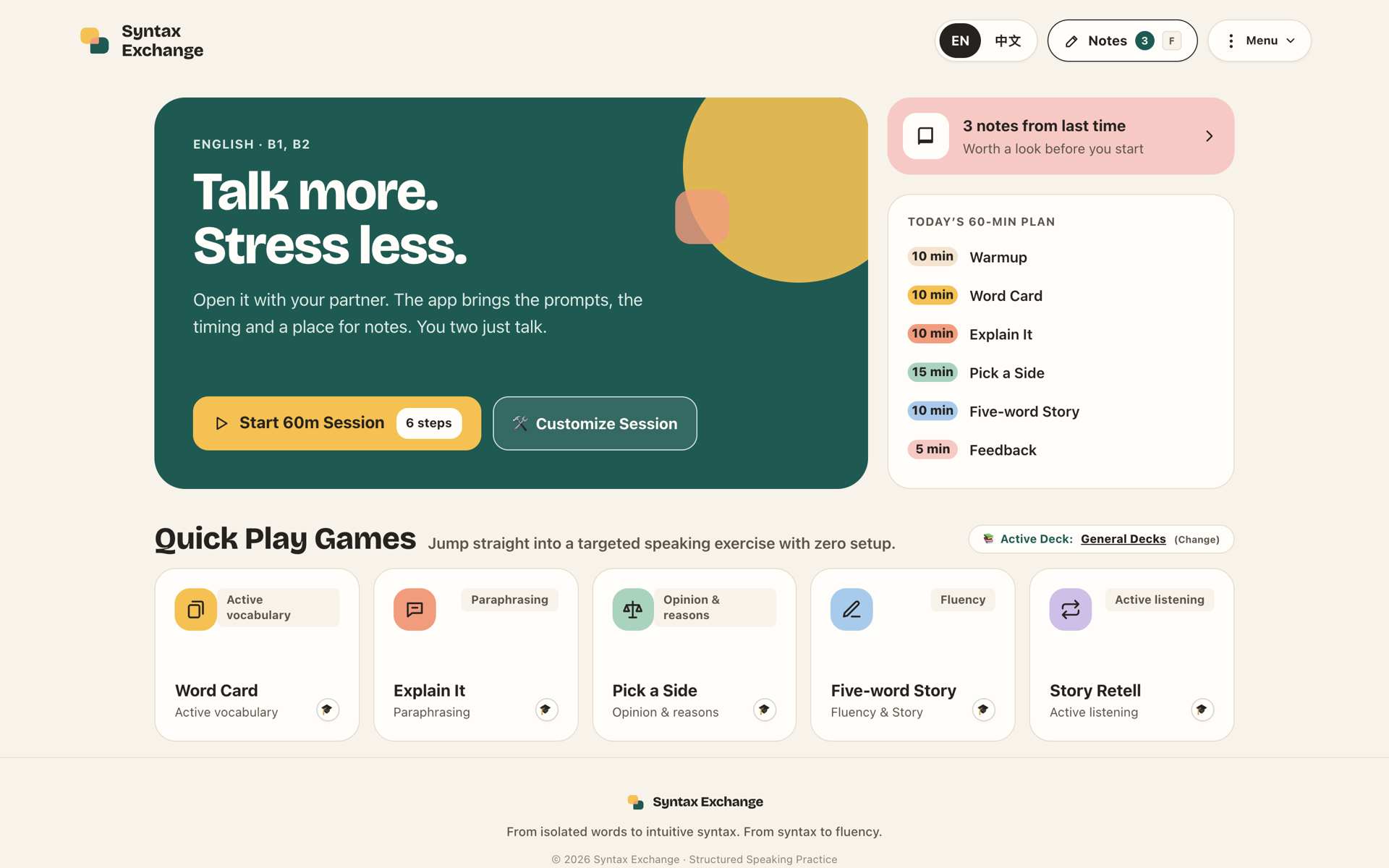
Syntax Exchange brings the prompts, the timer and a place for notes to your weekly language exchange. No prep and no scores: 30 to 60 minutes of structured, playful speaking practice.
Two voices.
One exchange.
The learner speaking: warm, bright, in the lead.
The partner answering: calm, steady, supportive.
Where both voices meet. That shared space is the exchange.
Every bubble keeps one pointed tail, aimed at the other voice.
Six games.
One skill each.
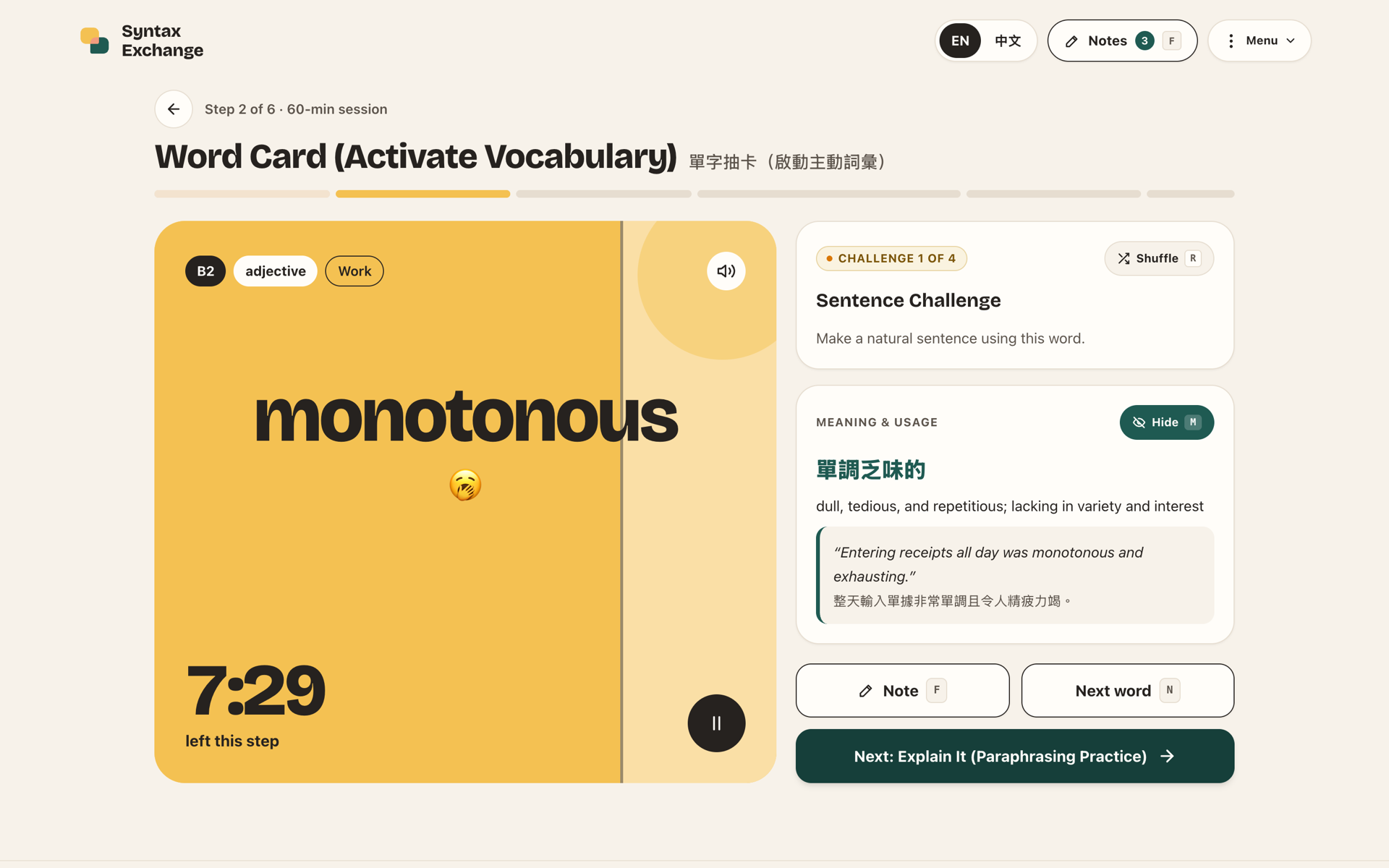
Draw a word and meet one of four challenges: a sentence, an explanation, a question for your partner, or a mini-story.
Describe a secret word in 60 seconds without saying any of its five forbidden words.
Take a side on a dilemma using a 4-step frame: opinion, reason, example, challenge.
Link five random words into one coherent 2-minute story, ticking each off as it lands.
Partner A tells a 2-minute story. Partner B listens without notes, then retells it.
Only you see the picture. Describe it so your partner can draw it, then compare.
From knowing a word to using it

- CEFR-leveled cards, A2 to C2, never repeated too soon
- Meaning stays hidden until asked (M); P reads it aloud
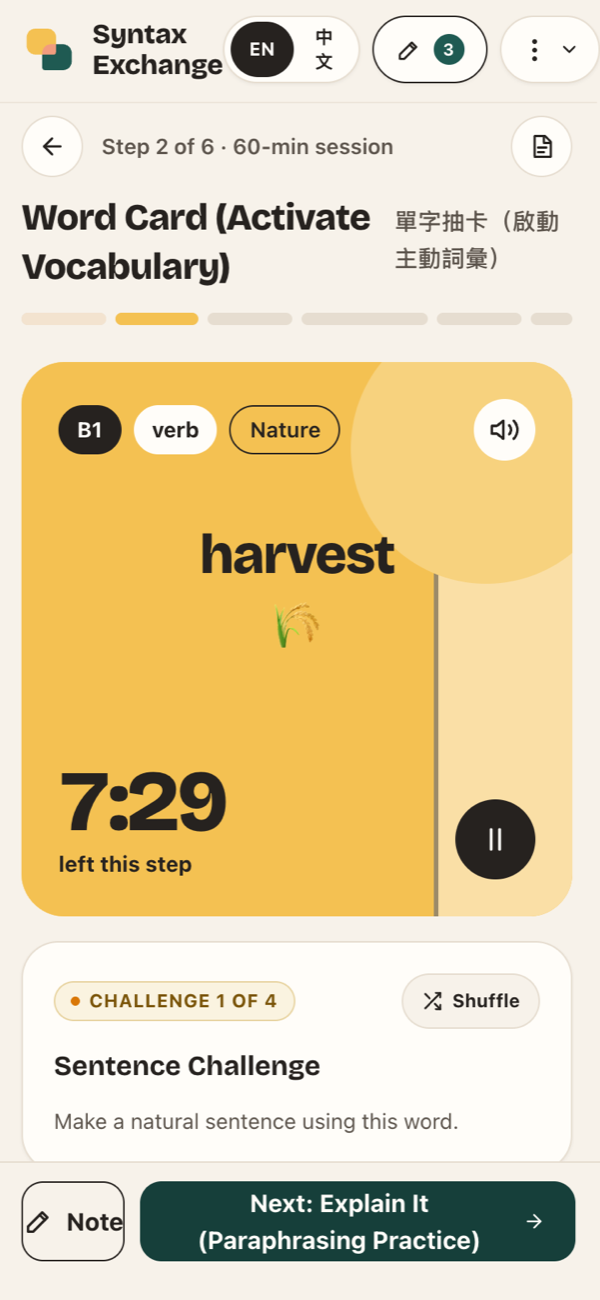
- In a session, the card itself is the timer: its color drains
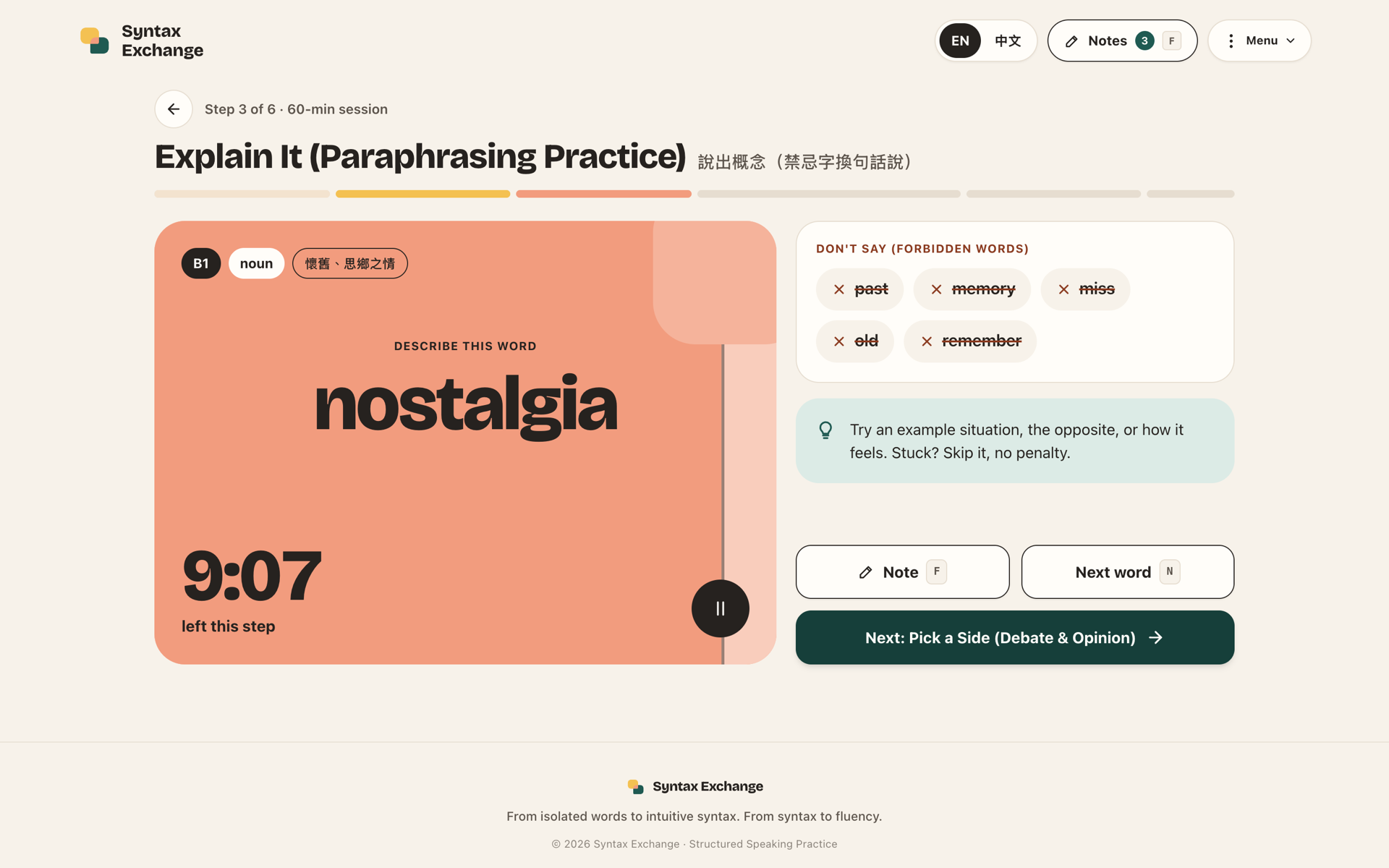
- Five forbidden words per card force real paraphrasing
- 60-second turns, skip with no penalty
- Strategy tip: examples, opposites, feelings
Longer turns, real conversation
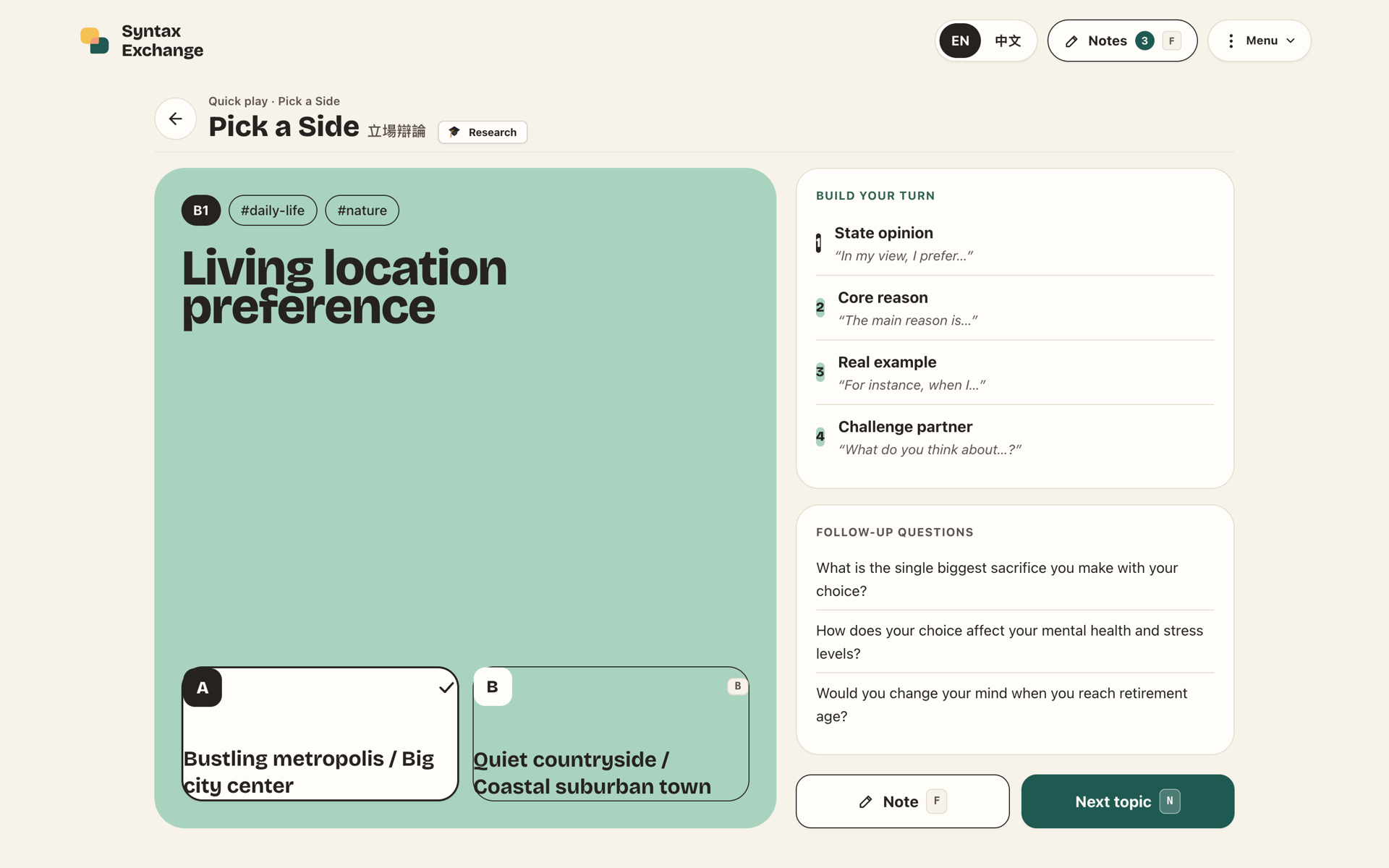
- Dilemmas from daily life to AI and careers
- Sentence starters for each of the 4 steps
- Follow-up questions keep the debate going
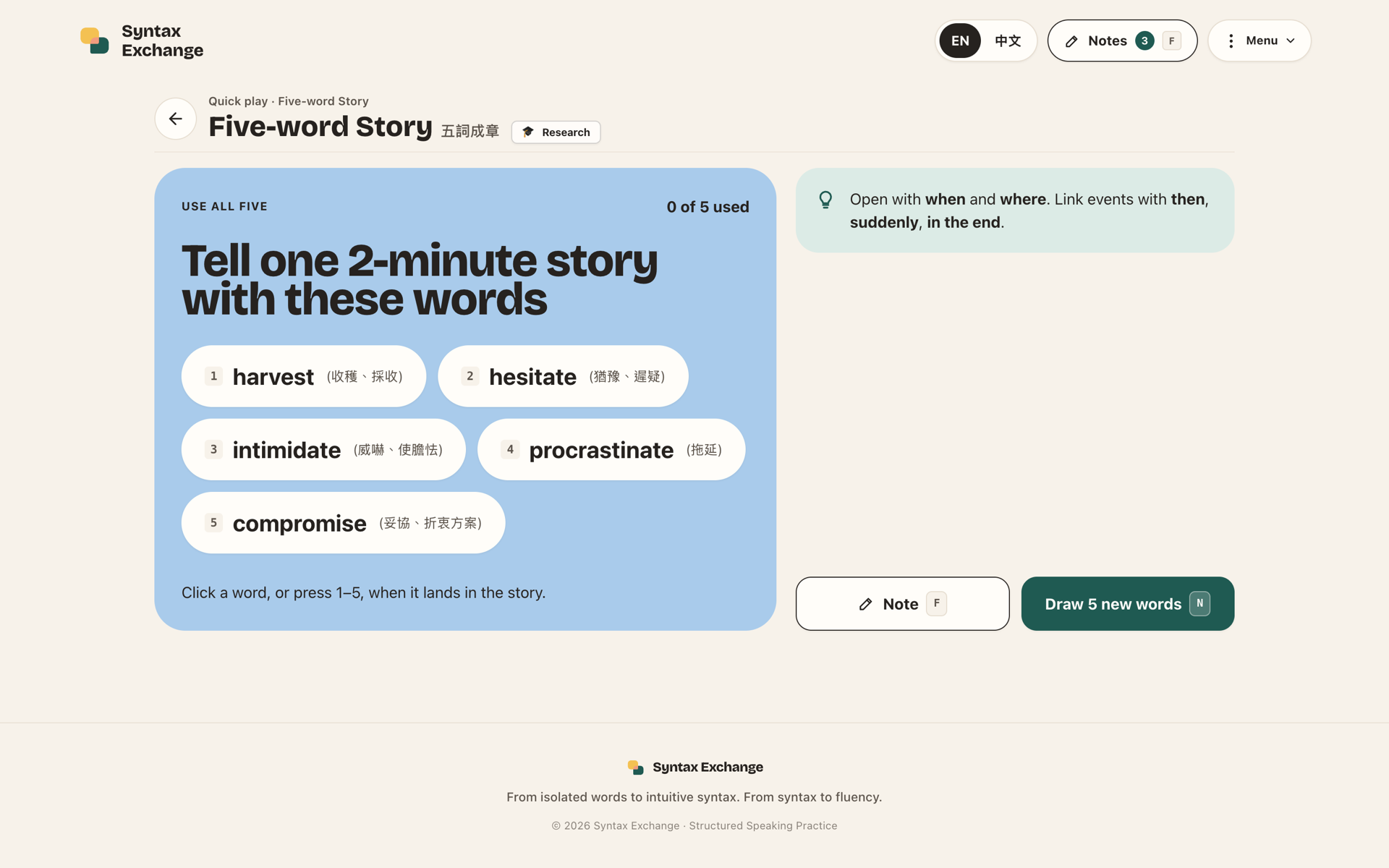
- Five random words with their translations
- Tap or press 1–5 as each word is used
- Connector hints: then, suddenly, in the end
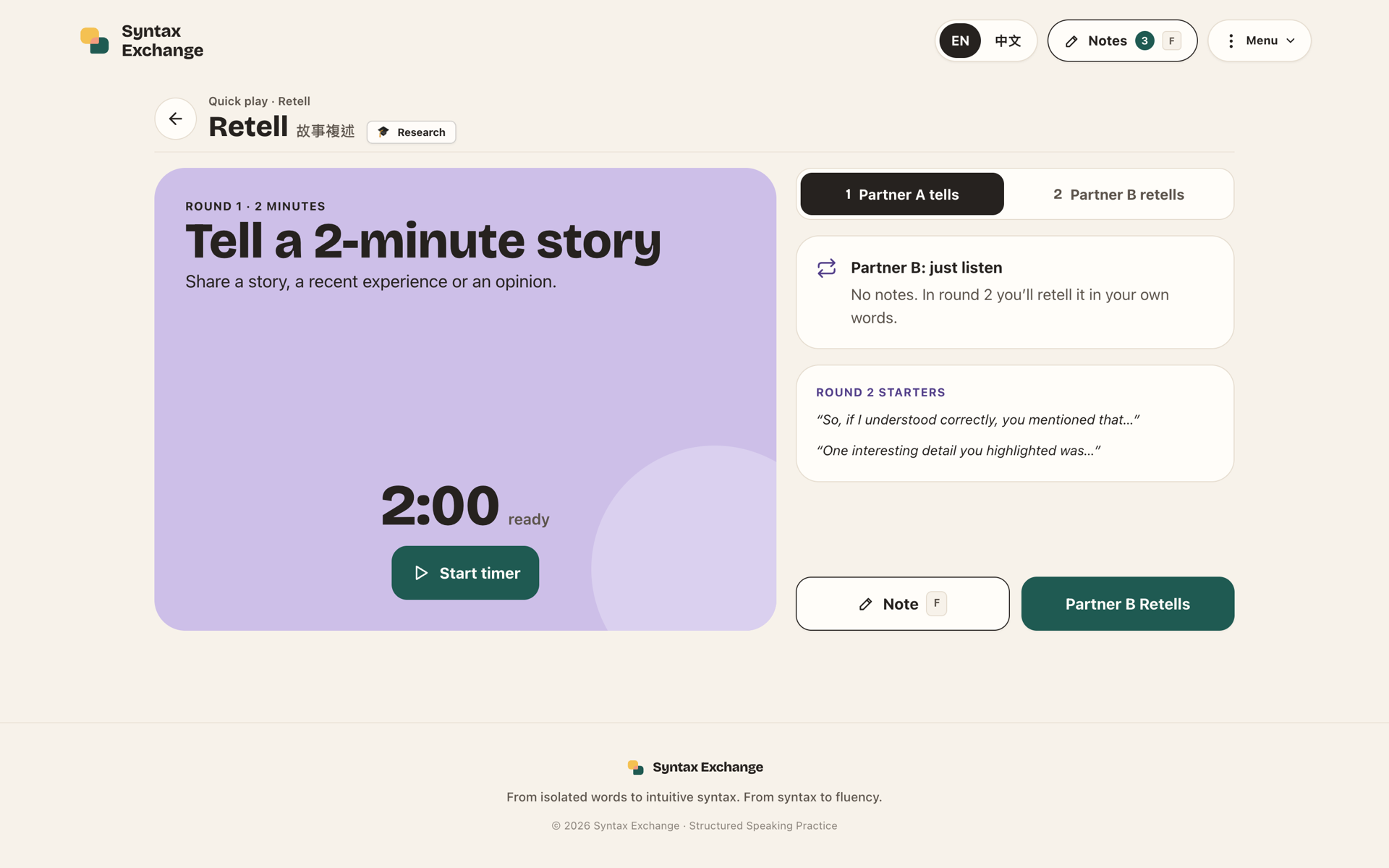
- Two rounds: A tells, B retells
- No notes allowed for the listener
- Retell starters: “So, if I understood correctly…”
Describe it. They draw it.
- Only A sees the picture: objects at A2–B1, shapes at B2–C1
- Pictures are generated by code, in every practice language
- 3-minute timer; N swaps in a new picture
- Remote room: B draws on an in-app canvas
- One device: B draws on paper
- B asks questions, then presses Done (Enter)
- Picture and drawing side by side
- A shared detail checklist: tick with 1–9
- Useful words to read aloud. No scoring
Plan, practice, review

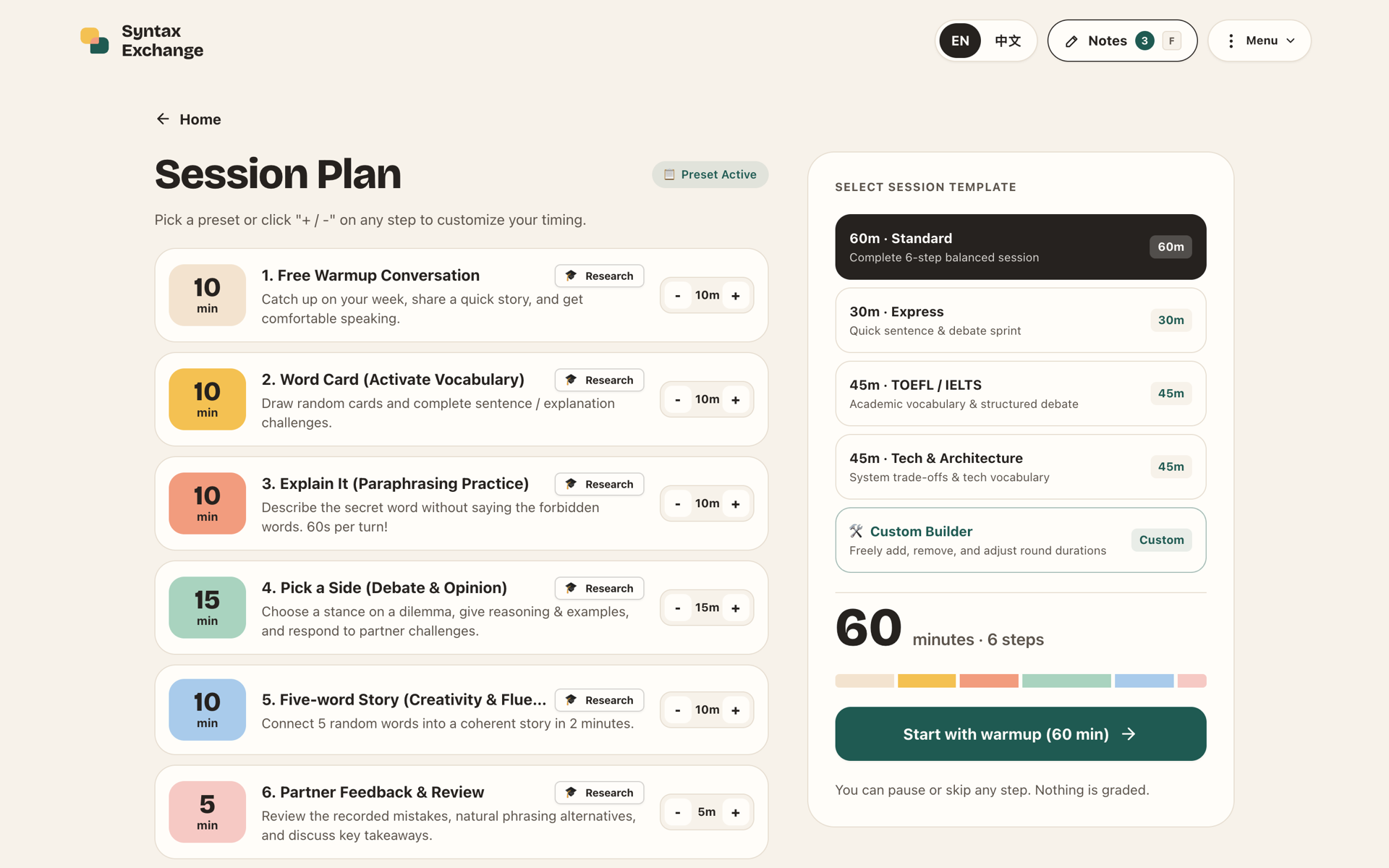
- 60-min standard and 30-min express plans
- Templates for TOEFL / IELTS and tech talk
- Builder: reorder, toggle and retime steps; skip mid-session
- Step timer drains the game card; coral in the last 15s
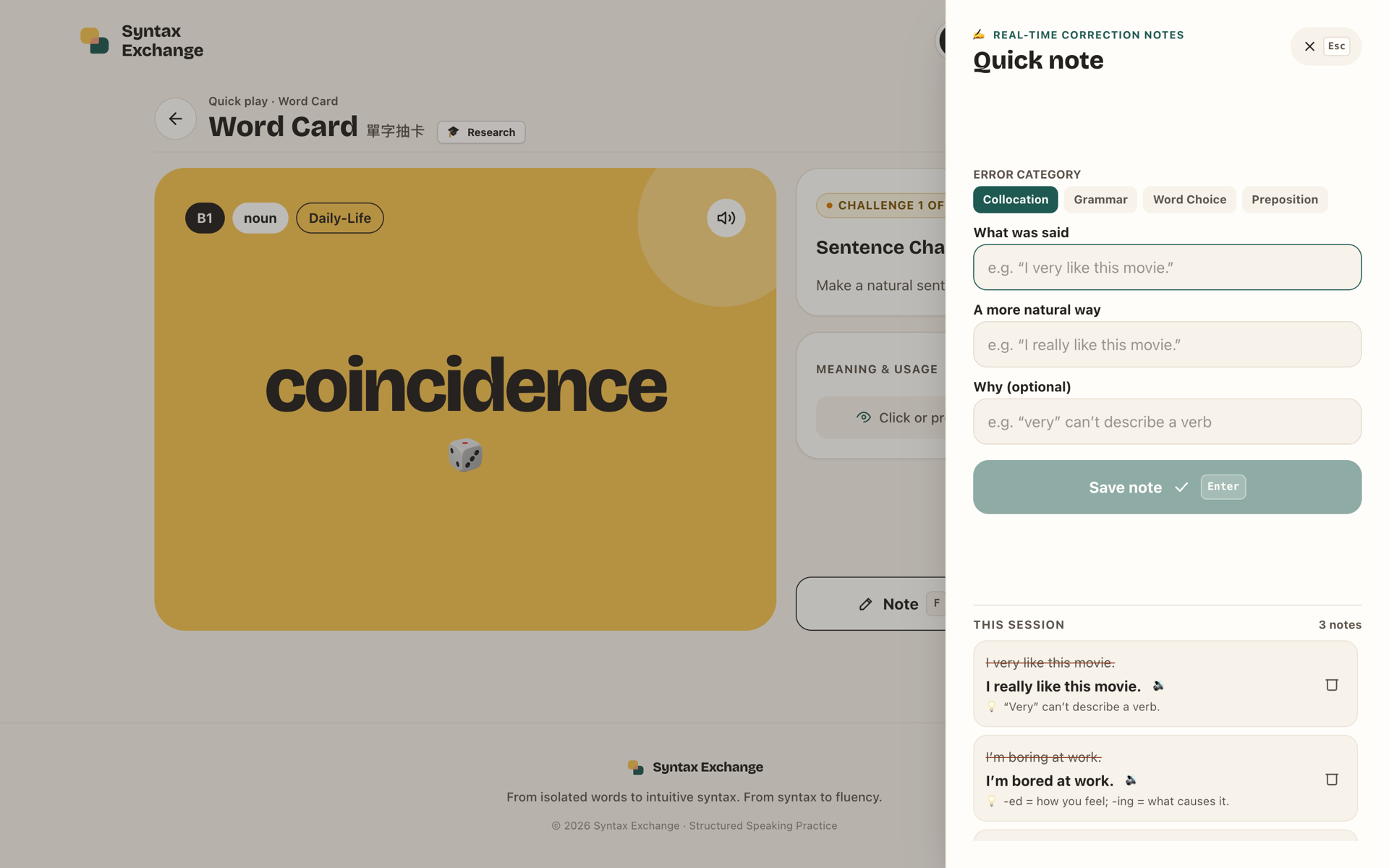
- Capture what was said and a more natural way
- Tag by category: grammar, collocation, word choice
- One key (F) opens it without stopping the talk
- In a room, a note goes to your partner’s own notes
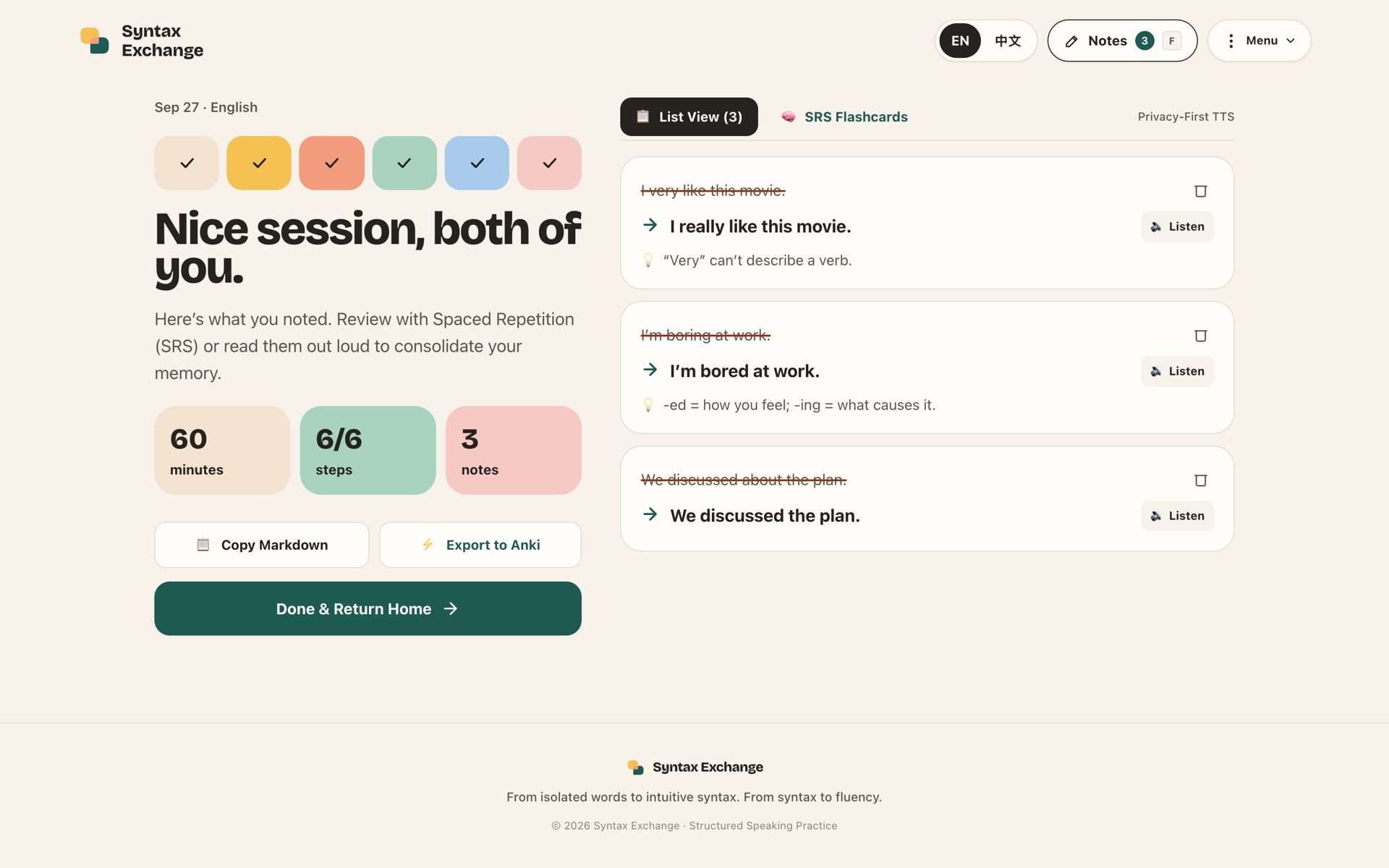
- Read any correction aloud in review
- Spaced-repetition review with read-aloud
- Export to Anki, CSV or Markdown
Grow with every conversation
- 1 leaf for every 10 minutes of active practice
- Flowers for the cards you review
- Fruit at milestones: first session, 5 sessions, 10 hours
- One tree for each partner you practice with
- Leaf colors show whose language was practiced
- A balance meter: give your partner a turn
- Counts active practice time, not taps
- Weekly, not daily: fits pairs who meet once or twice a week
- Never wilts: a missed week is just resting
- No streaks, no leaderboards
Built for the table,
not the classroom
Buttons in your language, content 100% in the target. Swap the pair in one click.
English, 中文, 日本語 and Español content, graded A2 to C2.
Share a link or code: same game, word and timer on both screens. Talk on any call app.
Sign in with Google to keep notes, decks and sessions on every device.
Built-in decks, or import your own from CSV or JSON, with forbidden words.
Never records your voice: no microphone, no audio upload.
Eyes on your partner,
not the screen
One key for every action in a session. Each button shows its key, and ? opens the full guide.
Local-first. Private by design.
No microphone access and no voice upload. Read-aloud uses the browser’s speech synthesis.
Without an account, notes stay in this browser. Signed in, they sync to your own account, protected by row-level security.
Vitest for the app and the game rules; pgTAP for the database’s access rules.
Every step maps
to a theory
Each part of a session is designed around second language acquisition research, and every game shows its citation in-app.
Research shapes the UX
No scores and a warmup first. The timer is a calm color drain, never a red countdown.
Every game ends in the learner speaking. Forbidden words push past direct translation.
Partners note errors silently; the review happens after speaking, not during it.
Words are pulled from memory under light pressure, then revisited with spaced review.
Only one partner sees the picture, so both ask, clarify and check. The drawing is compared, never scored.
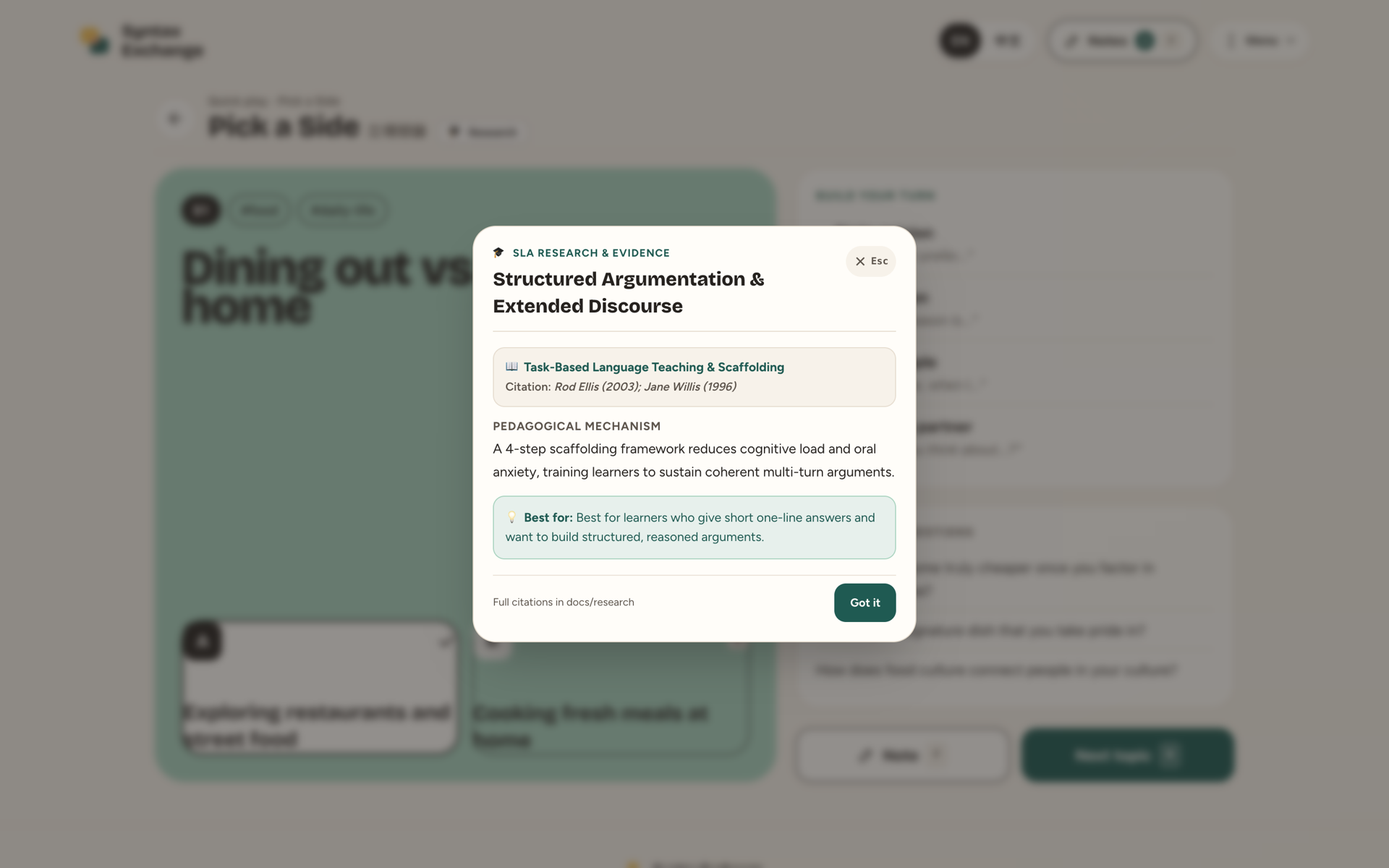
In-app: every game opens its research card with theory, citation and who it helps most.
What you can use today
- 6 games, now with Describe & Draw
- EN · 中文 · 日本語 · Español, one-click swap
- Remote rooms; notes go to the learner
- Practice Tree: your tree and pair trees grow as you speak
- Google sign-in; word lists for each level, A2–C2
- We are testing with ESL learners and teachers right now.
- What we build next depends on what you tell us.
- Try a game with your partner, then share what worked and what didn’t.
How much meaningful conversation did the pair have?
Not “how many words were memorized”. Every feature is judged by whether it helps people speak more, explain more and respond more.
Speak more.
Explain more.
Respond more.
From isolated words to intuitive syntax. From syntax to fluency.